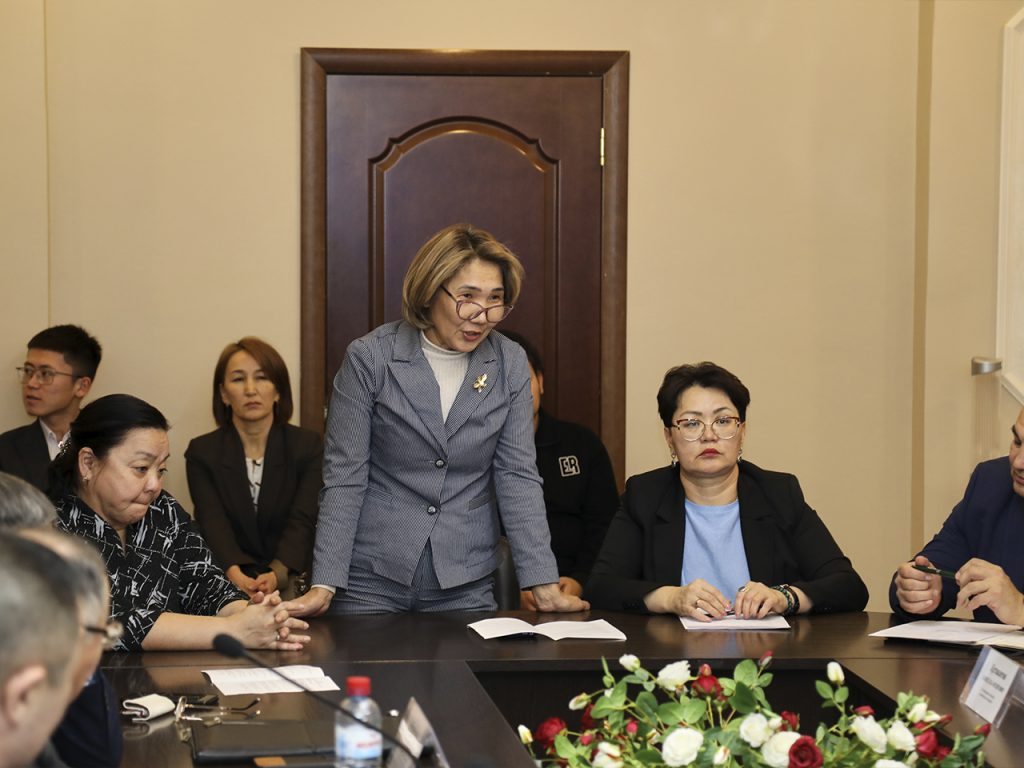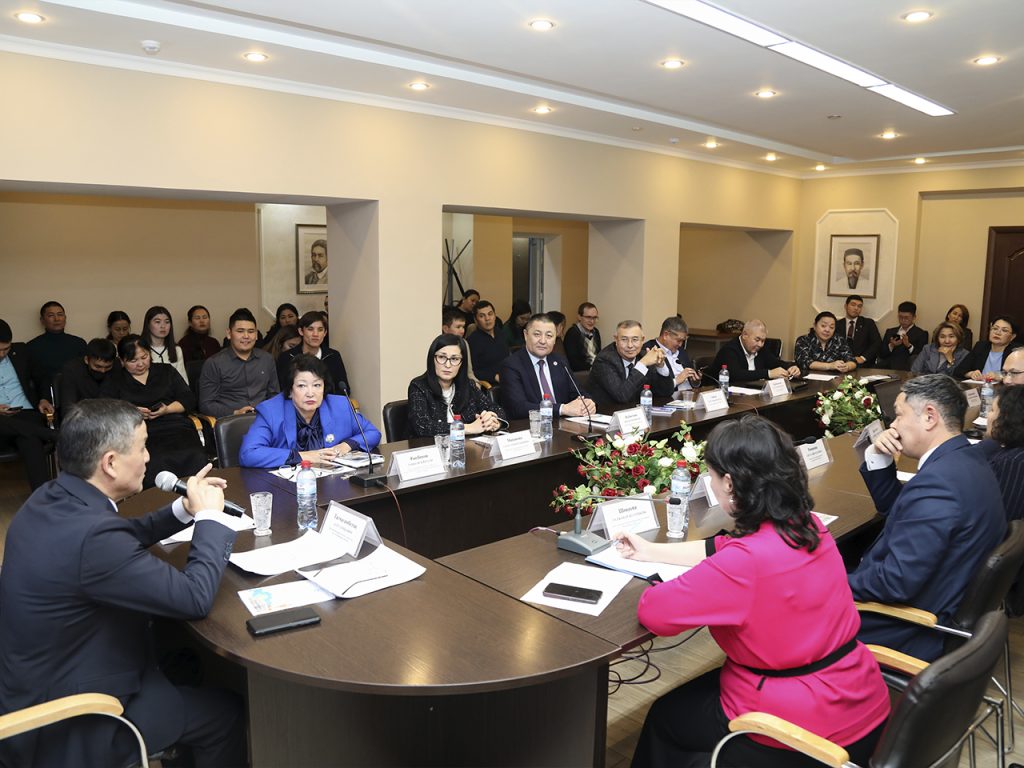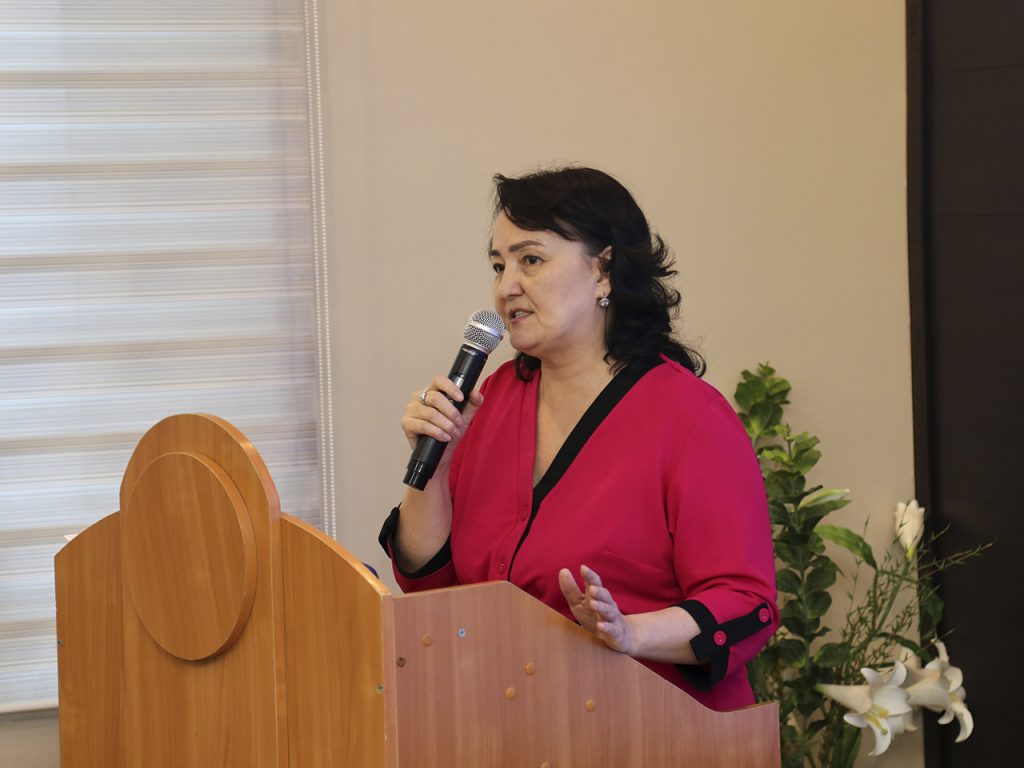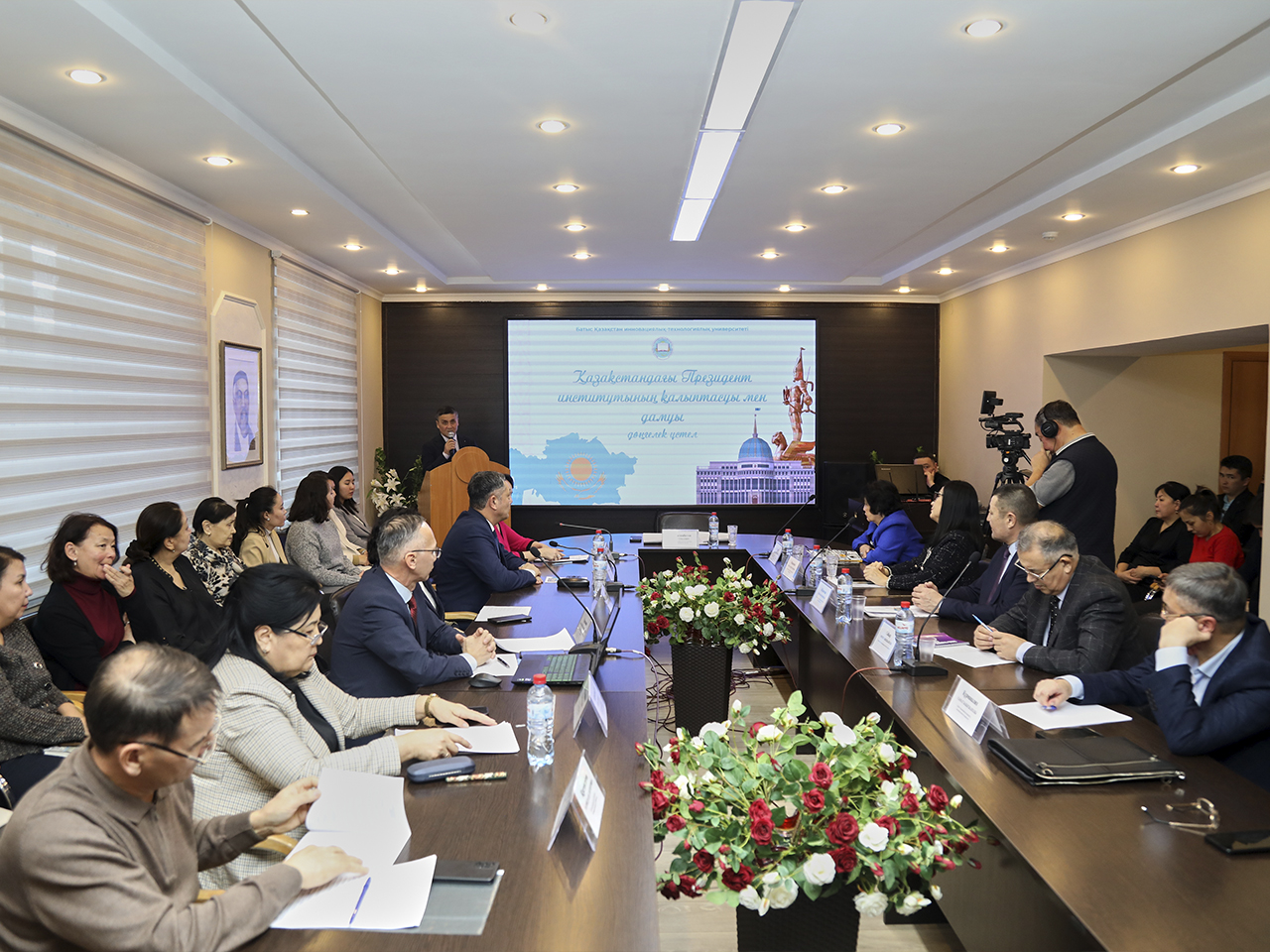
On November 29, 2024, a round table on the topic “Institute of Presidency in Kazakhstan: formation and development” was held at the West Kazakhstan Innovative and Technological University together with the Akimat of the West Kazakhstan region. In his welcoming speech, vice-rector for educational work of the West Kazakhstan Innovative and Technological University, Ayanbek Imanbaevich Abekeshev noted the importance of the institute of presidency in the formation of Kazakh statehood at the present stage.
In the report “Constitutional reforms and its impact on the development of the institute of presidency in Kazakhstan” by Tasmagambetov Asset Sembaevich, Doctor of History, professor, director of the Institute of Education and Management, the changes that laid the foundations of the country’s political system and their adaptation to new challenges of our time were analyzed. The speaker noted that constitutional reforms became a fundamental stage in the development of the political system of Kazakhstan, formed the principles of democratic institutions and created a balanced governance structure, which contributed to the sustainable development of the state. In his report “The Main Stages and Development of the Institute of Presidency in Kazakhstan”, head of the department of History and Law, Candidate of History, associate professor Yernazarov Zhaskairat Tlekkabyluly noted that the institute of presidency in Kazakhstan has gone through a complex and multifaceted path of development, which began during the crisis of the Soviet system. He spoke about a new stage of development, which opened within the framework of institutional reforms under the leadership of Kassym-Jomart Tokayev, aimed at creating a balanced management system based on stability. The report on the topic “Presidential Institute: Some Legal Aspects” was presented by Candidate of Legal Sciences, Associate Professor of the Department of History and Law Khamidulla Mukhitovich Kusdavletov. It analyzed the historical formation and evolution of the institute of presidency in Kazakhstan, considered the prerequisites for the creation of a state institution in the context of the crisis of the Soviet system of the 1990s, as well as its key role in ensuring political stability, effective governance and the implementation of reforms in the country. Particular attention was paid to the legal status of the President of the Republic of Kazakhstan, enshrined in the Constitution and legislative acts, as well as changes in his powers within the framework of constitutional reforms.
The report of the Candidate of History, associate professor of the Department of History and Law Abdrakhmanova Raisa Lesovna on the topic “Transition from a super-presidential model to a balanced political system: challenges and prospects” was devoted to the consideration of the process of decentralization of power by limiting the powers of the president, strengthening the role of Parliament and developing local self-government. Particular attention was paid to the 2022 reforms aimed at increasing transparency, democratization and creating conditions for political competition. The report noted that the reforms carried out contributed to strengthening the trust of citizens, adapting the institution of the presidency to modern challenges and creating a more sustainable political system. Despite such problems as the development of civil society and resistance from the elites, these changes created the basis for the long-term democratic and open development of Kazakhstan as a state. The final report was by Samat Bakhytzhanovich Kurmanalin, Candidate of History, professor of the History and Law department, on the topic “Prerequisites and features of the emergence of the presidential institution in Kazakhstan”, which examined the issues of the formation and development of the presidential institution in Kazakhstan, its role in foreign policy, in particular, the president’s initiative to abandon nuclear weapons and strengthen the country’s international authority. They also discussed the current reforms carried out under the leadership of President Kassym-Zhomart Tokaev, aimed at creating a “Fair Kazakhstan”, where the main priorities are democratization, justice and transparency of governance. This, according to the speaker, confirms the importance of the presidential institution in the future. After the main reports, debates were held, in which lecturers, students and magistrands participated.