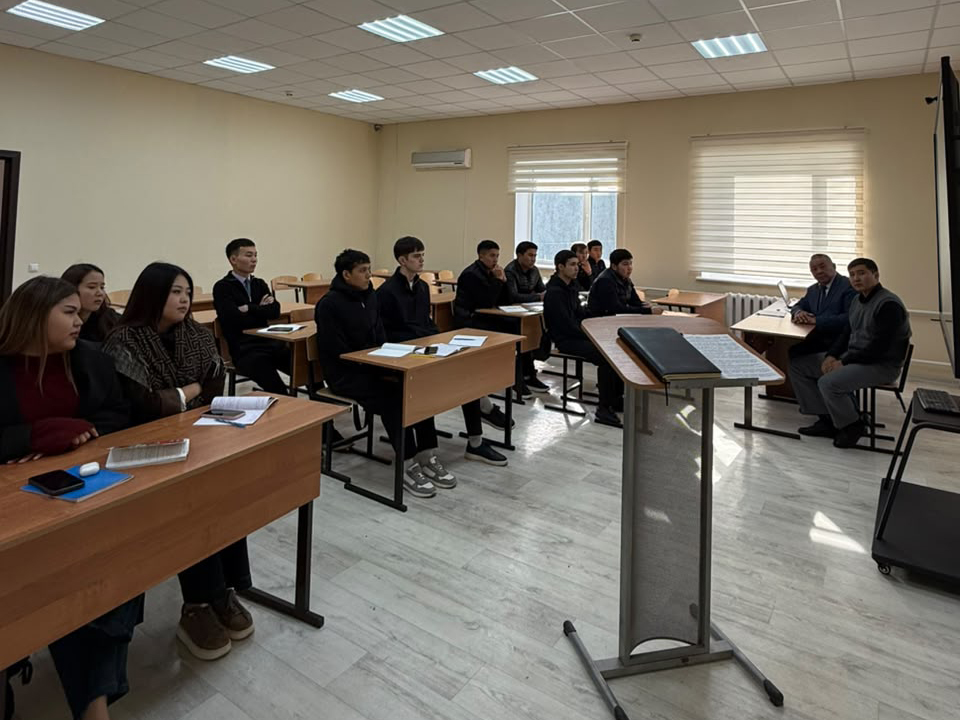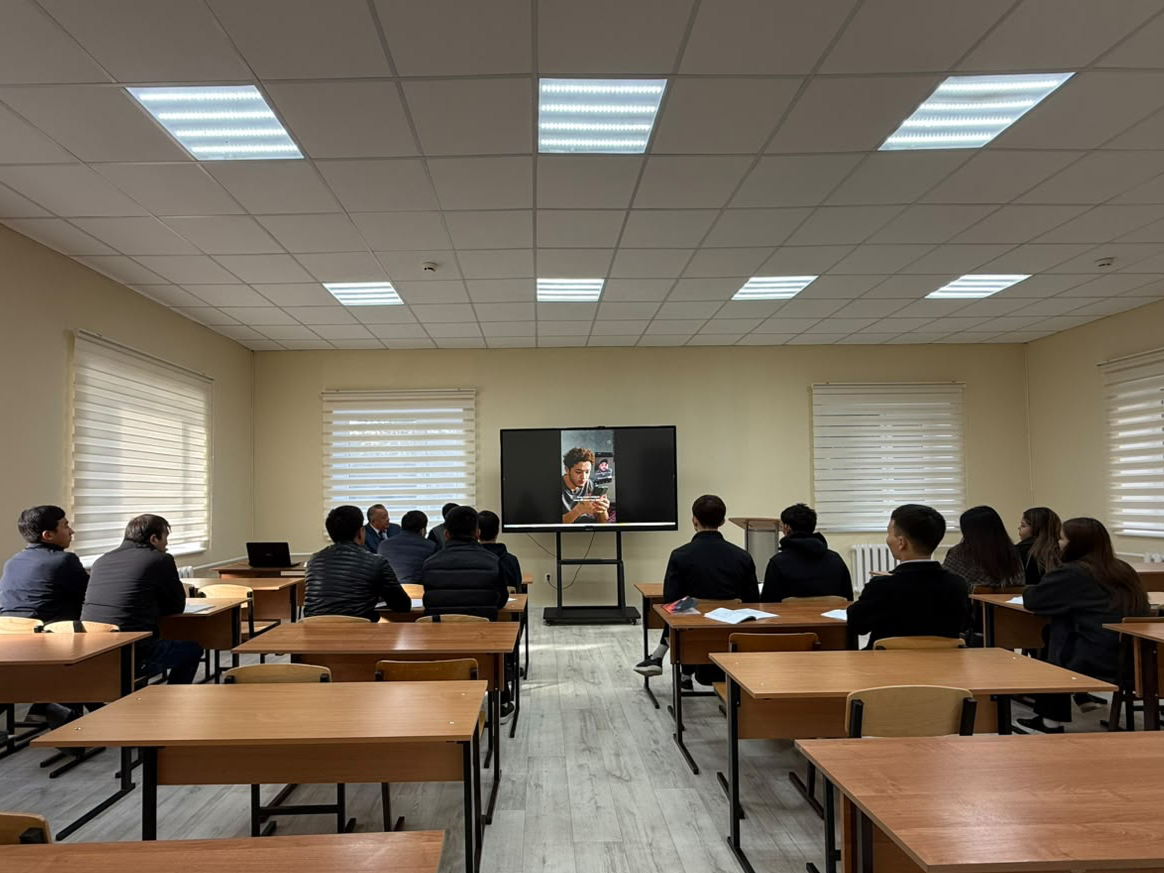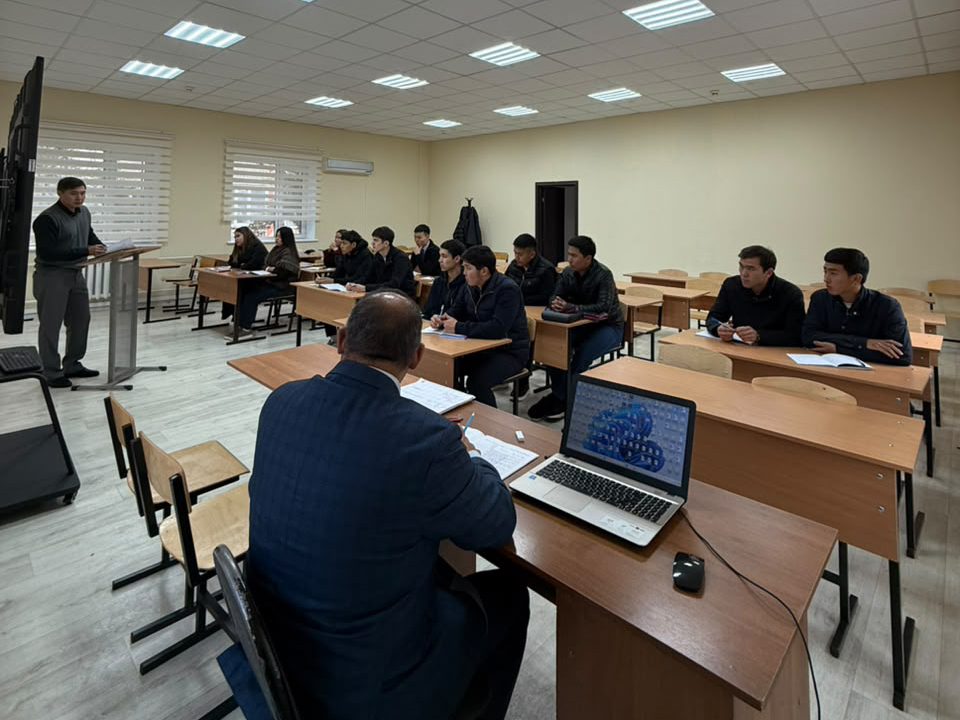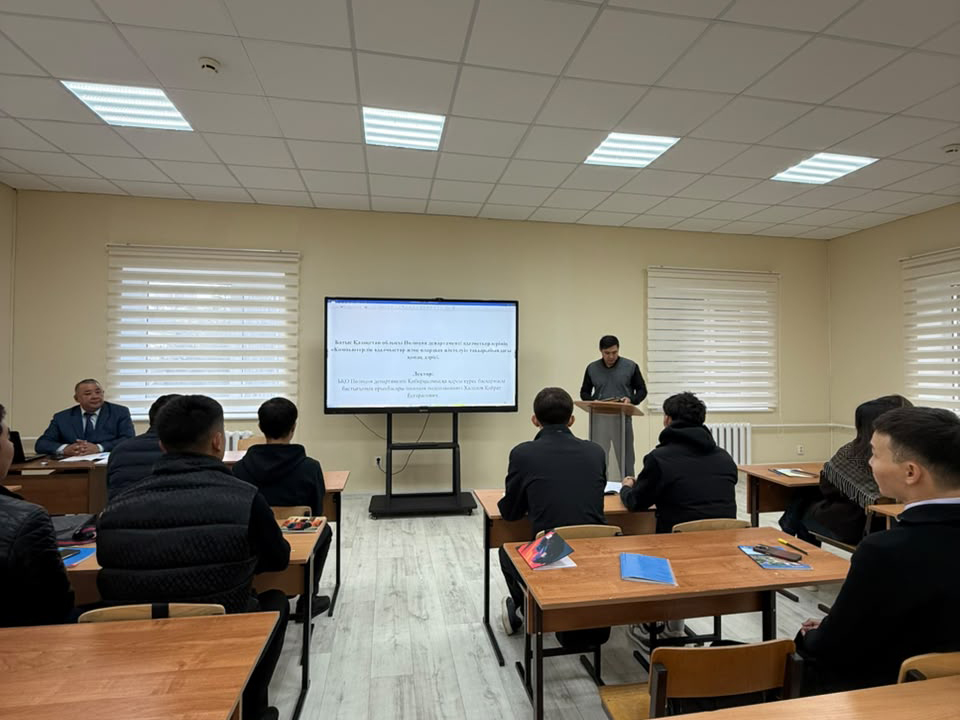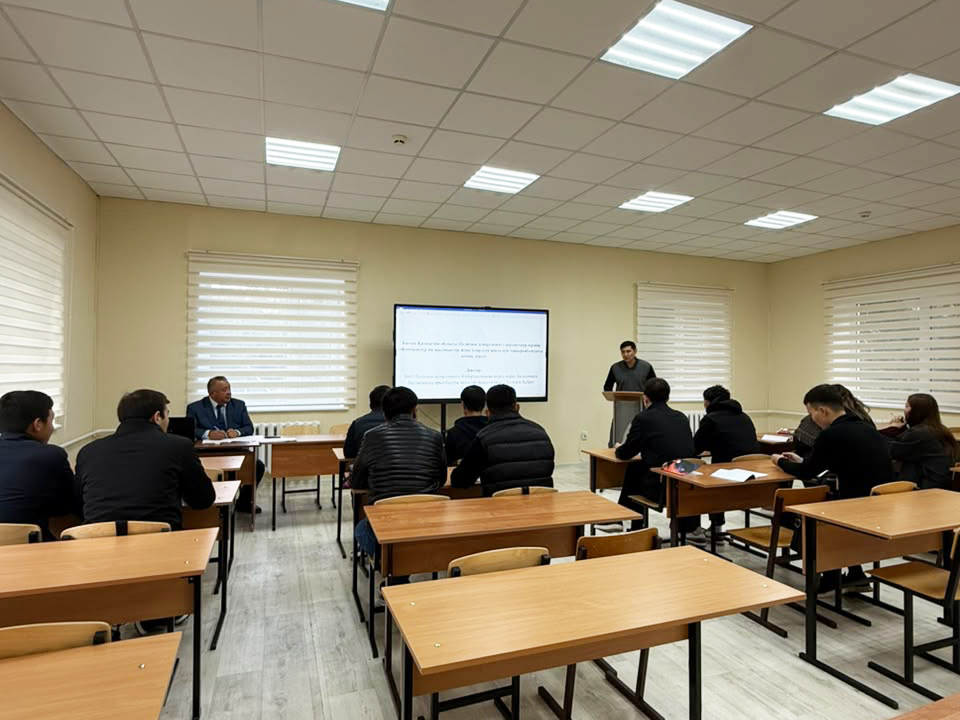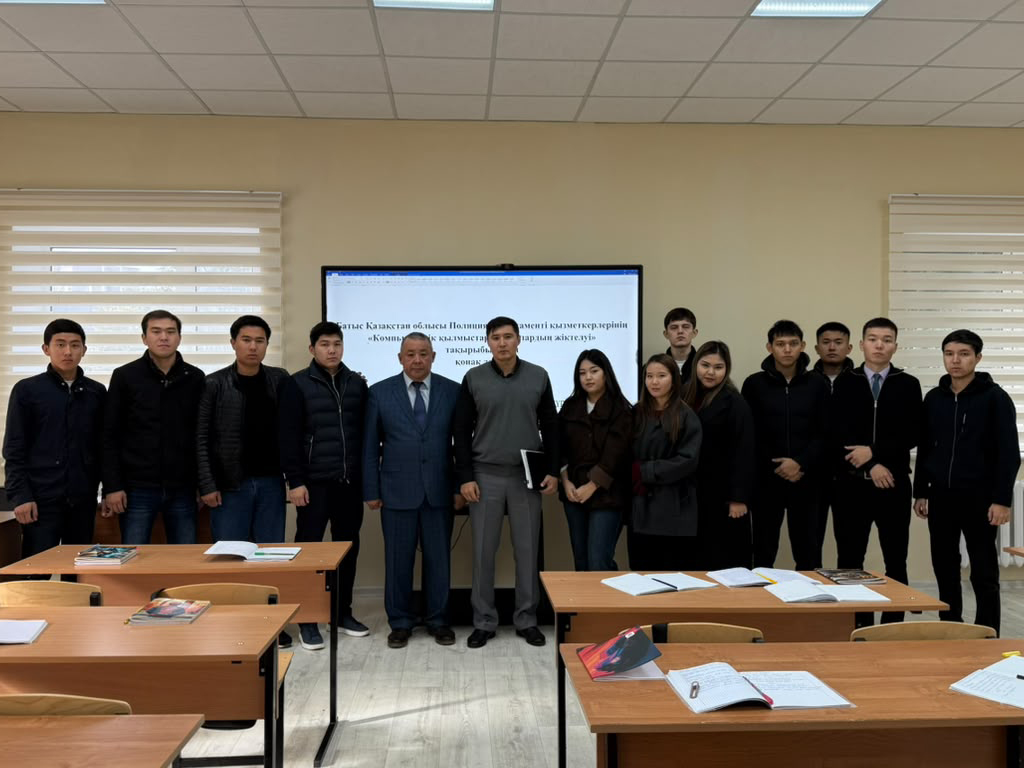
On October 6, 2026, the Department of Law of the West Kazakhstan Innovation and Technology University hosted a guest lecture for students of groups 31-O and 33-O enrolled in the 6B04202 “Jurisprudence” educational programme. The event was held within the framework of the Memorandum of Cooperation between WKITU and the Police Department of the West Kazakhstan Region.
The lecture, entitled “The Concept, Types and Classification of Computer Crimes,” was delivered by K.E. Khalelov, Deputy Head of the Cybercrime Counteraction Division of the Police Department of the West Kazakhstan Region, Police Lieutenant Colonel. The event was organised as part of the course “Legal Framework for Cybersecurity” and aimed to deepen students’ understanding of contemporary forms of cybercrime and law enforcement practices used to combat them.
During the lecture, Kairat Yesgarapovich presented current information on the state of cybercrime in the Republic of Kazakhstan and the West Kazakhstan Region. Particular attention was paid to criminal offences in the field of information technology and communications, as well as crimes committed through the use of digital technologies. According to the data presented by the lecturer, 353 cyber offences were registered in the West Kazakhstan Region during the first nine months of the current year, with financial losses suffered by citizens exceeding KZT 1 billion.
The lecturer discussed in detail the most common methods of online fraud. In particular, he provided examples of fraudulent schemes in which offenders impersonate employees of banks, government agencies, law enforcement bodies and utility service providers in order to obtain citizens’ personal data, gain access to bank accounts and unlawfully acquire funds.
Special attention was paid to the issue of money mules and criminal liability for providing bank accounts and other payment instruments for fraudulent transactions. K.E. Khalelov presented examples from regional law enforcement practice, including cases involving young people and students of educational institutions. In this context, the need to improve the digital and legal literacy of young people, comply with information security requirements and critically assess financial requests received through digital channels was emphasised.
The meeting also addressed cooperation between investigative and operational units and local police inspectors in the detection and investigation of cybercrime. The lecturer explained the procedures for collecting and securing evidence, identifying and tracing persons involved in criminal offences, bringing offenders to criminal responsibility, and applying modern digital technologies in law enforcement activities.
The practical part of the lecture included thematic video materials and discussion of specific cases. Students had an opportunity to ask questions directly to a law enforcement representative and discuss issues related to the legal classification, detection and prevention of cyber offences.
At the conclusion of the meeting, T.Kh. Rakhmetov, Associate Professor of the Department of Law and Candidate of Legal Sciences, expressed gratitude to K.E. Khalelov on behalf of the faculty and students for the informative lecture and the practice-oriented discussion of current issues in combating cybercrime.