
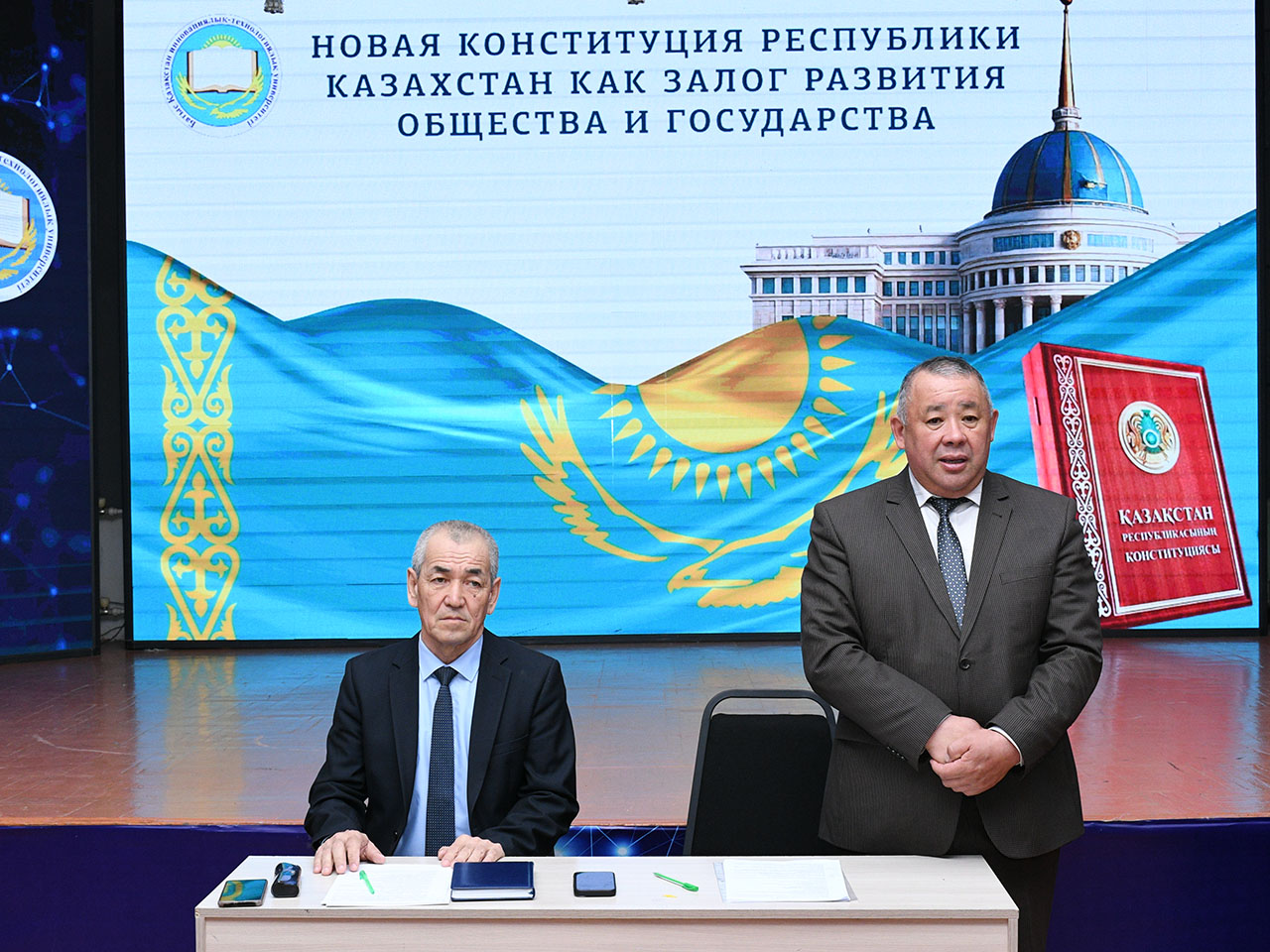
On April 20, in the assembly hall of the academic building of ZKITU at 44 M. Ikhsanov Street, a lecture was held for first-year IOT students. It was delivered by Associate Professor of the Department of Law, Candidate of Legal Sciences T.Kh. Rakhmetov on the topic “The New Constitution as a Guarantee of the Development of Society and the State,” and Senior Lecturer E.A. Karagoyshiyev on the topic “New Guarantees of Citizens’ Constitutional Rights.”
The new Constitution of the Republic of Kazakhstan, adopted on March 15 of the current year in a nationwide referendum, saw participation from more than 73% of citizens, with over 87% voting in favor of its adoption. The Constitution consists of 11 sections and 96 articles. Many of the students present in the hall took part in the referendum for the first time, thereby exercising their constitutional right to participate in elections.
In his speech, T.Kh. Rakhmetov explained to students the new Preamble of the Constitution and its differences from the previous one, where greater emphasis is placed on building a new society and state based on the traditions of the Great Steppe, the principles of a Just Kazakhstan, and adherence to law and order.
In order to strengthen statehood, develop democracy, and enhance people’s power, amendments have been introduced into the institution of the Presidency in the new Constitution: the presidential term is limited to a single seven-year term, and a new position of Vice President of the Republic of Kazakhstan is introduced. The country’s bicameral Parliament will be replaced by a unicameral Kurultai consisting of 145 deputies. Deputies will be elected in August of the current year for a five-year term based on party lists; currently, 7 political parties are operating.
A significant role is assigned to the new supreme consultative and advisory body—the Khalyk Kenesi in Kazakhstan, created to strengthen cooperation between society and the state. It will include 126 members divided into three groups of 42 representatives each: from ethnocultural associations, maslikhat deputies, and representatives of civil society. This body will have the right of legislative initiative, the authority to initiate nationwide referendums, and the ability to express the consolidated opinion of the people on strategic issues of the country’s development.
The institution of marriage and family is also being strengthened in the country. Article 30, paragraph 2 of the Constitution states: “Marriage is a voluntary and equal union of a man and a woman, registered by the state in accordance with the law.”
E.A. Karagoyshiyev, in his speech, emphasized the strengthening of citizens’ rights and freedoms in the new Constitution. Article 86 of the Constitution establishes, for the first time, the institution of the Bar (advocacy) in our state. It facilitates the realization of the human right to judicial protection and to receive legal assistance guaranteed by the state. The international Miranda rule is introduced when a citizen is detained by law enforcement and special agencies.
The lecturers answered all the students’ questions, wished them success in their studies, and encouraged them to be active citizens of our independent country.