
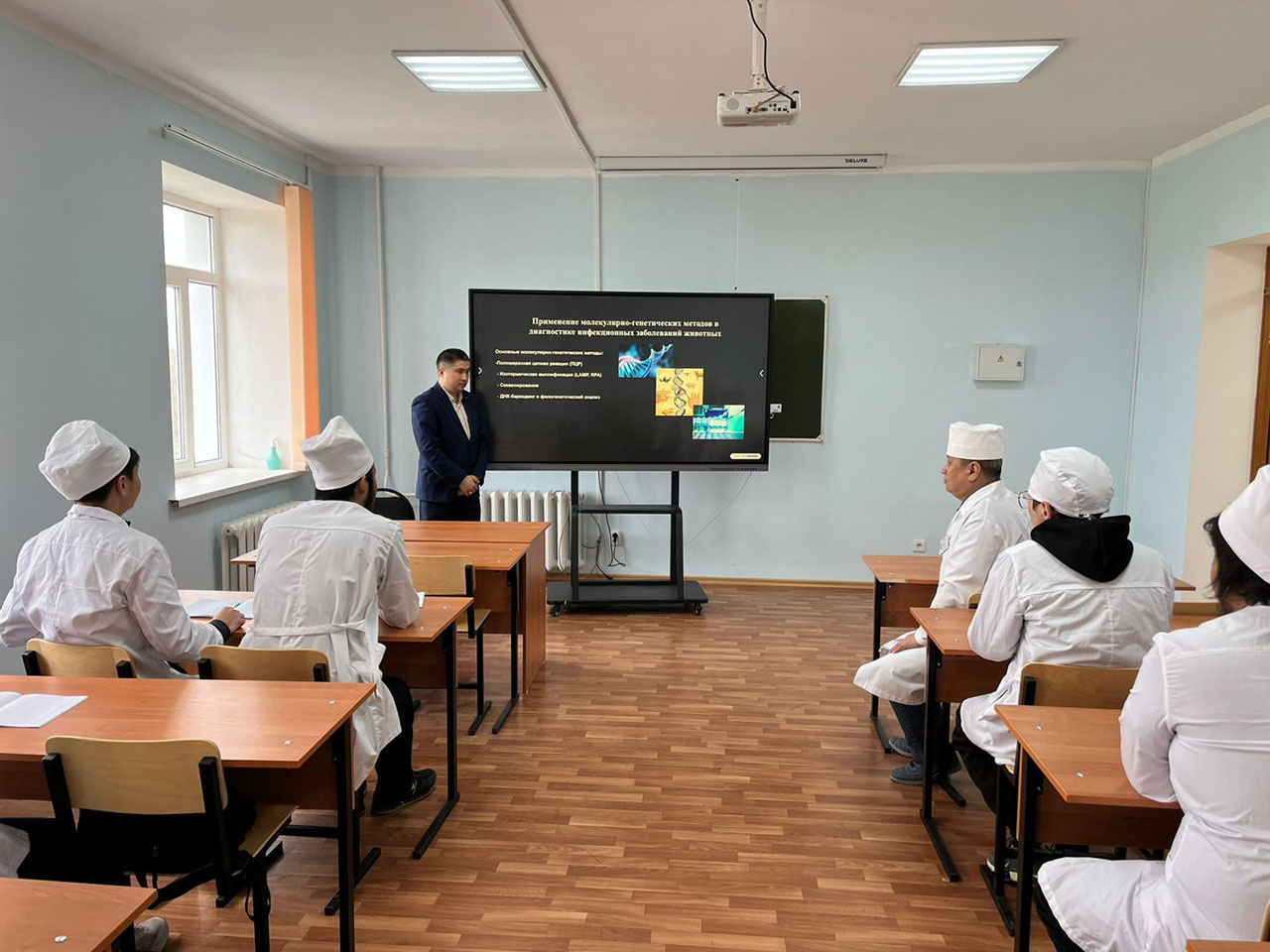
On April 15, 2026, at the initiative of Associate Professor of the Department of Veterinary Medicine and Technosphere Safety of the Institute of Industry Technologies of West Kazakhstan Innovative and Technological University, Candidate of Veterinary Sciences A.K. Dnekeshev, a Guest lecture was organized for 3rd-year students of the educational program “Veterinary Medicine” in accordance with the departmental plan. The event featured a meeting with PhD, Associate Professor of M. Utemisov West Kazakhstan University, Murat Galikhanovich Kakishev.
The lecture topic was “Application of Molecular Genetic Methods in the Diagnosis of Infectious Diseases of Animals.” The event was held at the Veterinary Clinic of the Department of Veterinary Medicine and Technosphere Safety of the Institute of Industry Technologies of West Kazakhstan Innovative and Technological University.
The purpose of the guest lecture was to deepen students’ professional knowledge in the field of modern diagnostics of infectious animal diseases, as well as to develop their understanding of the potential for implementing molecular genetic methods in veterinary practice. Particular attention was paid to the development of analytical thinking and to understanding the role of high-precision laboratory technologies in ensuring epizootic well-being.
The lecture content covered both theoretical and applied aspects of the use of molecular genetic methods, including polymerase chain reaction (PCR), DNA sequencing, hybridization techniques, and bioinformatics analysis. The lecturer подробно examined the principles of early detection of infectious disease pathogens, issues of method specificity and sensitivity, as well as their advantages over traditional diagnostic approaches. Practical examples of applying these technologies in the diagnosis of viral, bacterial, and parasitic diseases in animals were also presented.
A distinctive feature of the lecture was the combination of fundamental scientific material with a practice-oriented approach. The use of real cases from the lecturer’s professional experience enabled students to better understand the importance of molecular diagnostics in veterinary medicine. In addition, the interactive format of the meeting encouraged active student participation in discussions, which improved the level of knowledge assimilation and stimulated interest in research activities.
In conclusion, it should be noted that the guest lecture held possesses high educational and practical value. The knowledge gained contributes to the development of modern professional competencies required for working in the context of digitalization and technological advancement in veterinary medicine. The event also strengthened interuniversity cooperation and highlighted the importance of integrating science and education.