
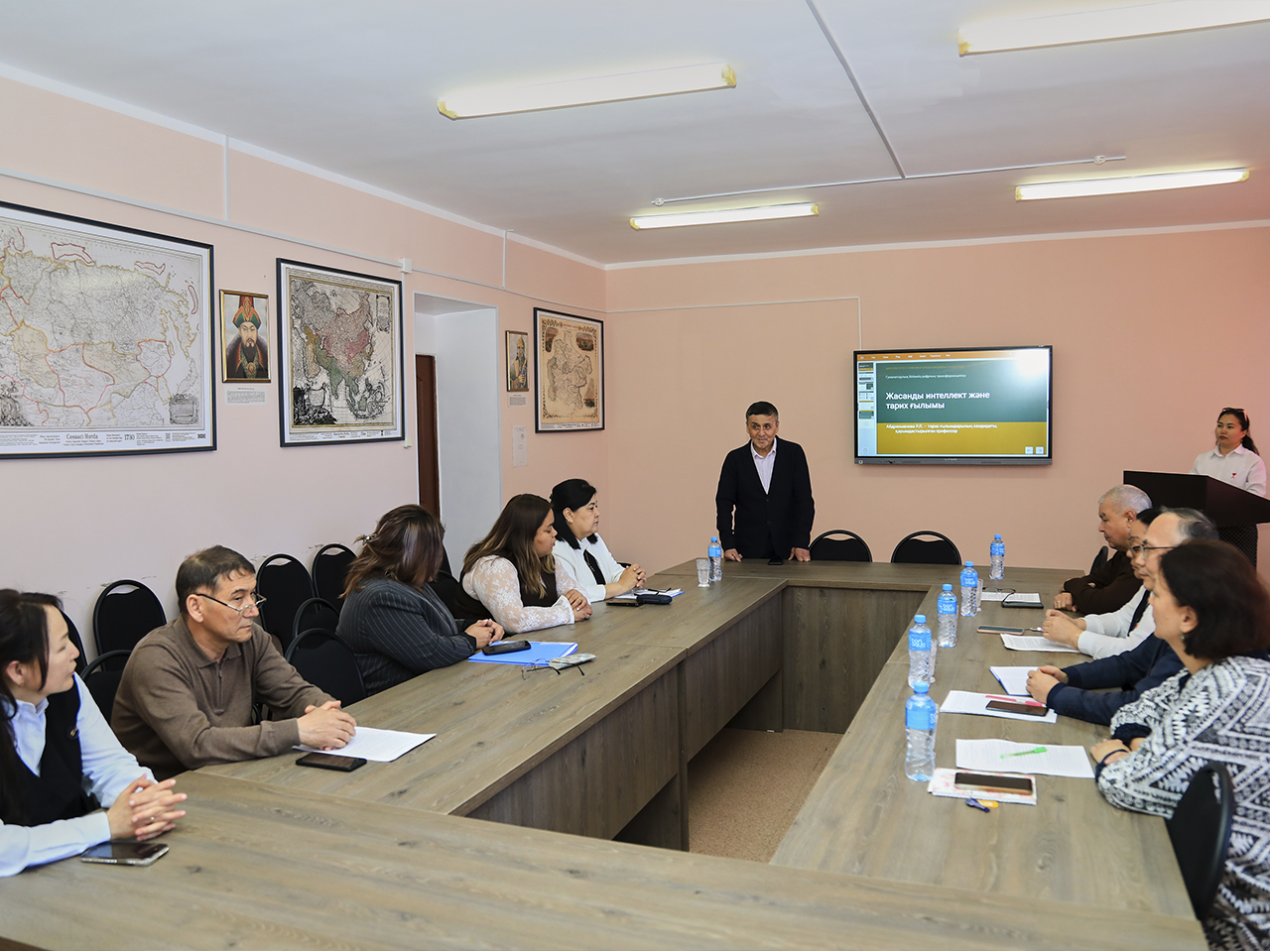
On April 16, 2026, as part of the “Decade of Science 2026” events, timed to coincide with Kazakhstan’s Scientist Day, the Department of History and Law held a roundtable discussion on “Digital Transformation of Humanities Education: The Role of Artificial Intelligence in the Study of History and Legal Science.”
The main purpose of the event was to discuss the potential application of artificial intelligence in the humanities and legal fields, as well as explore ways to digitally transform scientific research and the educational process.
Faculty, young scientists, and graduate students participated in the roundtable discussion. Participants discussed digital transformation processes in the humanities education system, modern research methods in historical science, and current issues in the application of artificial intelligence in the legal field.
The following key areas were addressed during the event:
- Current issues in the digitalization of the humanities;
- Use of digital technologies in the analysis of historical data;
- The role and potential of artificial intelligence in legal research;
- issues of digital ethics and legal regulation.
The speakers noted the effectiveness of using artificial intelligence in legal analysis, studying judicial practice, and making legal decisions. Furthermore, the possibilities of processing big data in historical science, the use of digital archives, and the modeling of historical processes were widely discussed.
The roundtable became an important platform for promoting the development of science in the context of the digital transformation of humanities education.
